Materials
Cold-Shrink vs. Heat-Shrink Terminations: What Actually Changed
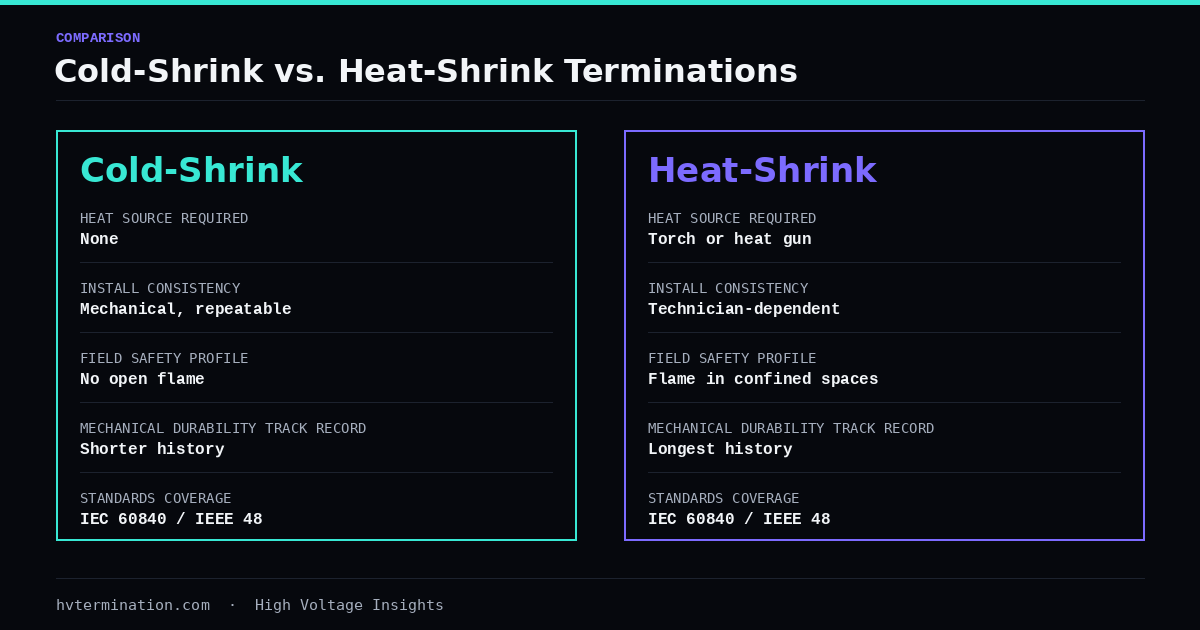
For decades, terminating a shielded HV cable outdoors meant a propane torch, a heat-shrink sleeve, and a technician’s steady hand shrinking it down in the right sequence without scorching the insulation underneath. Cold-shrink terminations were built to remove exactly that step — a pre-stretched, pre-expanded silicone or EPDM body that’s held open on a removable core and simply pulled off in place, contracting around the cable without any heat source at all. Twenty-plus years after cold-shrink went mainstream, it’s worth being precise about what that actually changed and what it didn’t.
What Cold-Shrink Removes From the Job
The most immediate change is the one crews notice first: no torch, no propane bottle, no open flame near cable insulation and jacket material that can be damaged by uneven heating. That’s a genuine safety improvement in confined spaces — inside a switchgear cabinet, a manhole, or a wind turbine tower base — where ventilation is limited and a heat gun or torch is one more variable to manage under time pressure. Installation is also faster and more consistent: pulling a removable core is a repeatable mechanical action, while heat-shrink installation quality depends on even heat distribution, correct dwell time, and a technician’s experience with that specific product line.
Where Heat-Shrink Still Has the Edge
None of that makes heat-shrink obsolete. Heat-shrink terminations have a longer field history at the highest voltage classes and are generally regarded as more mechanically robust once installed — the material fully conforms and bonds to the cable surface under heat in a way a cold-shrink body, held in place by elastic memory alone, doesn’t quite replicate. For terminations facing severe mechanical stress, extreme temperature cycling, or the very top of a given voltage class’s rating, heat-shrink is still frequently the specified choice, and plenty of utility specifications reflect that conservatism.
Offshore wind is a useful example of installation conditions driving the choice: dropper cable terminations inside a turbine tower base are built in a cramped, humidity-variable space where a torch is one more complication crews would rather not manage, which is part of why the offshore wind industry has leaned toward cold-shrink and factory pre-termination together.
Standards Don’t Pick a Side
Neither IEC 60840 nor IEEE 48 mandates one shrink technology over the other. IEEE 48 defines termination performance classes — Class 1A for extruded-dielectric cable, for instance — and a pollution severity guide that determines the creepage distance a termination needs for a given outdoor environment; both cold-shrink and heat-shrink products are manufactured to meet those same requirements. The standards test the finished termination’s performance, not the process used to build it, which is exactly why the shrink-technology decision usually comes down to installation conditions and mechanical duty rather than a standards mandate.
The Practical Decision
For a straightforward outdoor termination on a moderate voltage class where crews are working in the open and installation speed matters, cold-shrink’s case is strong. For the highest voltage classes, unusually severe mechanical or thermal duty, or a utility with a long-standing heat-shrink specification and a proven maintenance history to match, there’s still a legitimate argument for staying with it. The honest framing isn’t “cold-shrink has won” — it’s that the torch is no longer a forced requirement, and that’s changed which factors actually drive the decision. Reynard fits both technologies to project-specific requirements rather than defaulting to one, which is the more useful starting point than picking a side in the abstract.
Sources: 3M — The benefits of cold-shrink vs. heat-shrink, IEEE 48-2020 standard overview.