Materials
Silicone vs Porcelain Outdoor HV Cable Terminations: How to Choose the Housing
When an outdoor termination is specified, the conversation usually starts with voltage, conductor size and creepage. The housing material, porcelain or polymeric silicone, often gets settled by habit. It deserves a deliberate decision, because it affects safety, installation effort, maintenance and how much creepage fits in the available space.
This article summarises what published industry sources say about the trade-off and ends with a checklist you can use in a specification review. It is a planning aid, not a design rule; the product standard and the manufacturer’s type-test evidence always govern.
What the Housing Actually Does
Whenever a cable meets an overhead line or an open-air installation, the outer semiconducting layer has to be removed and the insulation covered. The termination then has three jobs: grade the electric field where the screen ends, cover the polymeric insulation, and provide the external creepage the pollution conditions demand. The housing mostly carries the third job, and it also encloses the field-control element, whether that is a geometric stress cone or a nonlinear grading material.
Two housing constructions are common. In one, the outer silicone insulation is moulded directly over the stress cone. In the other, the stress cone sits inside a hollow insulator, which can be porcelain or composite. The material question is separate from the field-grading question, and mixing the two up is a common reason specifications get confused.
Where Silicone Housings Have an Edge
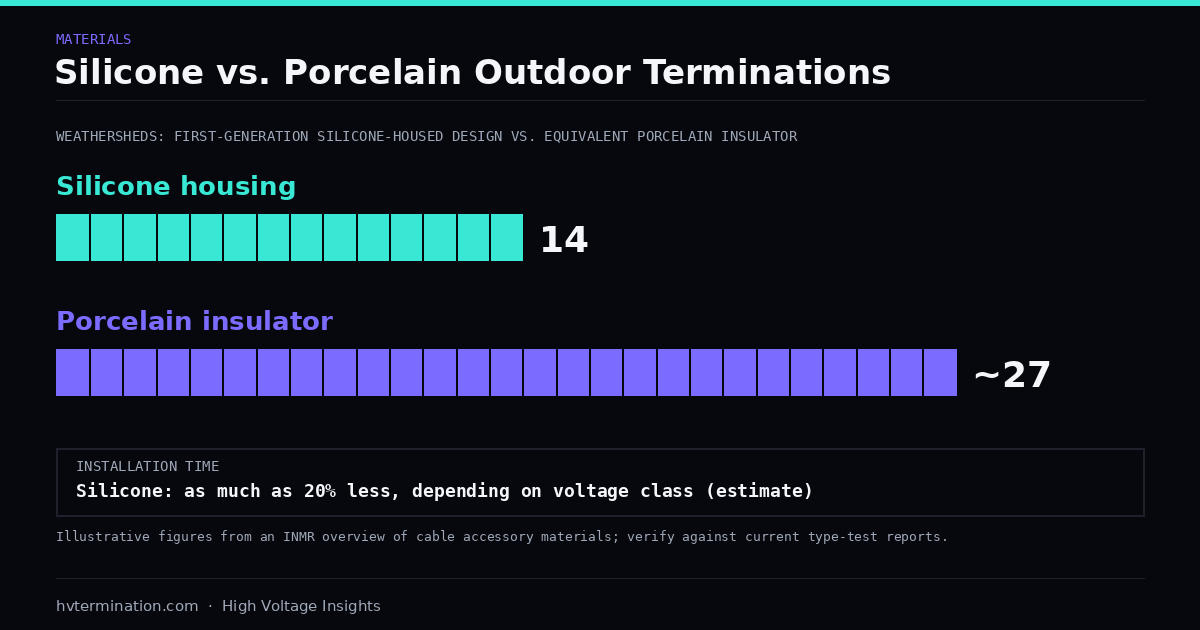
An INMR overview of cable accessory materials, drawing on contributions from silicone and accessory suppliers, reports that silicone-housed HV terminations are a growing segment. It lists several advantages over porcelain: increased safety, lower environmental risk and faster installation. The article estimates installation time could be as much as 20 percent shorter depending on voltage class, which is an estimate rather than a guarantee for any given project.
The most useful property outdoors is hydrophobicity. Silicone sheds water and resists wetting, which the same source links to more economical designs with shorter creepage and lower maintenance than porcelain. The example it gives is striking: a first-generation silicone-housed termination had 14 weathersheds where an equivalent porcelain insulator needed much longer creepage and around 27 sheds. Treat that as an illustration of the principle, not a sizing rule for your site.
Material grade matters too. The source describes erosion-resistant liquid or high-consistency silicone rubber with hardness of roughly 25 to 40 Shore A as well suited to terminations, and notes that high elasticity allows assembly without special tools. The industry has been moving the same way as it did earlier at medium voltage, where polymeric terminations have long been the norm.
Where Porcelain Still Gets Specified
None of this makes porcelain obsolete. Porcelain has a very long service record, many utilities hold established procedures and spares for it, and some owners prefer to stay with a known material for critical connections. The trade-offs to weigh are mostly practical:
- Weight and handling at height, where a lighter housing is easier to lift and fit.
- Failure behaviour, where the safety argument for polymeric housings sits.
- Creepage per unit length, which decides whether a termination fits the available clearance. The creepage and pollution severity guide explains how to derive the requirement first.
- Long-term ageing of a polymer in your specific climate and pollution, which only the supplier’s type-test and service evidence can address.
Note the age of the evidence base. The INMR article was first published in 2012 and republished in 2025, so the sheds-versus-porcelain example describes first-generation designs. Current products, from any supplier, should be judged on current test reports.
Specification Checklist
Before you lock the housing material, confirm the following in writing:
- The pollution class and the resulting specific creepage requirement for each termination location.
- Which standard governs the hollow insulator, if one is used. IEC 61462 covers composite hollow insulators, including definitions, test methods and acceptance criteria.
- Type-test and routine-test records for the exact design offered, not a product family.
- Mechanical loads at the termination: cantilever, wind, ice and the pull of the connected conductor.
- Installation method. Whether the termination is built on site or in advance has a bigger effect on quality than most material choices; see our comparison of cold-shrink and heat-shrink terminations for the same logic applied to installation technique.
- Spares and replacement strategy over the asset life.
Practical Takeaway
Choose the housing last, not first. Fix the pollution class and creepage need, then ask each supplier to show how their silicone and porcelain options meet it with documented type tests. If a silicone design meets the creepage in a shorter, lighter package, the saving is real; if the site is constrained by an existing porcelain footprint or procedure, say so in the tender so suppliers price the right scope.
Whichever material you pick, the termination is only as good as its installation and acceptance testing. Reynard describes offshore termination and testing services for array cables, export systems and offshore substations, which is a useful reference point when you compare how providers present installation and test evidence.
Sources: INMR — Design, Materials & Manufacturing of Cable Accessories, IEC 61462:2023 — Composite insulators, hollow insulators for use in outdoor and indoor electrical equipment.